Grant Exposed
Huddersfield Town’s annual collapse has come a lot earlier than usual this season, with the (admittedly limited) initial promise extinguished before the clocks go back.
Another Kevin Nagle/Jake Edwards managerial appointment is disintegrating before our eyes, as Lee Grant’s inexperience and curious devotion to robotic management-speak are cruelly exposed in a spiral that has been staggeringly rapid.
There doesn’t appear to be any way back for the young boss, with a fanbase thoroughly sick of disastrous decisions that have taken us from a Championship play-off final to mid-table in League One — with a trajectory that currently promises worse, despite a squad that should achieve a top-six place as a minimum.
Arresting a slide in football is not an easy task, as Huddersfield Town’s history tells us, with stabilisation the most difficult to achieve. Nagle and Edwards have overseen some appalling decisions, none of which have even vaguely contributed to a reversal of fortunes; quite the opposite.
Sacking Duff for overseeing an injury-ravaged blip in form and abandoning any hope of reaching the play-offs should go down in the annals of monstrously bad HTFC decisions — but this shouldn’t dissuade them from terminating Grant, though it likely will in their contrarian way.
Facing a side with a terrible away record — including a recent 3–0 defeat at Burton, of all places — going one up during an unusually positive first 15 minutes, and comfortably, if tediously, holding the visitors at bay until injury time, Grant managed to oversee a quite incredible but increasingly predictable defeat.
Bolton, vulnerable in a first half that deteriorated in quality as it went on, were let off the hook by an inept Town attack featuring a ponderous Taylor and the criminally wasted, out-of-position May — posing little and diminishing threat.
Over-cautious and lacking bravery or thrust, Town relied on the occasional foray forward by Roosken. Sadly, his industry — including containing Bolton’s best player — eventually exhausted him, and his removal from the pitch proved portentous.
In that first 15 minutes, Town attacked with good intent, forcing corners and putting the visitors on the back foot.
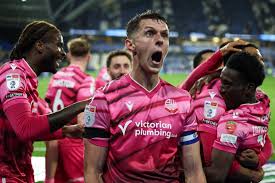
A goal-bound May effort slammed into Taylor, who couldn’t get out of the way, and the striker had another effort blocked before a good corner delivery by Roosken cleared the first defender for once and was headed home very well by Castledine.
That early lead seemed to weigh on the shoulders of both management and team, as they got progressively worse as the half went on and never looked like adding to their score to dishearten a vulnerable opponent.
Nicholls was called upon to make a hugely important save late in the half when Cozier-Duberry finally got the better of Roosken and played in Forrs, who shot too close to the keeper.
It was a sign that Bolton had a lot more to them than they had shown up to the break, while Town’s withdrawal into themselves with the comfort of a lead became ever more evident.
The second half was a tactical disaster on all sorts of levels from Town’s beleaguered young manager, as his team gradually but perceptibly faded in the face of a side growing in confidence and sensing blood.
Despite a good performance, on the whole, from the back four, the Ledson–Kasumu axis failed yet again in a malfunctioning midfield largely starved of the ball by their increasingly tenacious opponents.
Pushed deeper and deeper, Town’s coherence was already creaking when Grant made the quite ludicrous decision to replace Taylor with Dion Charles, who just a short time ago was assumed to have no future at the club.
Miller also made a welcome return but could add nothing to the team other than join in the attempt to suppress Bolton’s star turn — an effort completely upended when the exhausted Roosken had to leave the field and was replaced by Roughen, who couldn’t cope with the threat.
Nicholls went down with a mystery injury on 75 minutes to allow for a break and managerial instructions, which was probably not the brightest of moves. Bolton’s players and staff couldn’t have helped noticing that three or four Town players were trying to stretch out aching limbs, sending further encouragement to the by-now entirely dominant Trotters.
While the equaliser was very, very late, it was no surprise at all. Cozier-Duberry was by now menacing Town’s new left side and delivered a great cross to the back post, which was guided in by Daley past a helpless Nicholls.
It was the least the visitors deserved, despite how late it came for them. They had a reasonable penalty appeal turned down when Nicholls seemed to collide with McAtee, having been played in by Conway, who had sliced through several failed challenges to set up the opportunity — and they dominated the ball against tiring Town legs.
A disappointed and increasingly disgruntled crowd had just digested the loss of two points when the other one was seized in front of their disbelieving eyes.
As a Town attack broke down, Bolton broke into prairie-level open spaces, culminating in Burstow releasing Cozier-Duberry to fire past Nicholls, who got an upper arm to the effort but couldn’t deflect the ball enough.
Bolton’s adventure and bravery — epitomised when they grabbed the ball out of the net to go again after the equaliser — delivered a crushing blow to Grant, his knackered team, and a half-empty ground still waiting for the front-foot style promised by Nagle’s flippant “Northern football” nonsense, bizarrely latched upon by Town’s communications people.
Patience is now exhausted, and while it is doubtful that Nagle and Edwards will take timely action given their past performances, it is time to admit their huge error in giving a novice manager not only the job but also extensive power and influence.
There seems no end to Town’s travails — despite, and probably because of, the constant changes they have made. While it seems counterintuitive to make yet more changes, they surely must.

 townreports