However good it was, and Johnnies Night Club will hold a special place in the hearts of Huddersfield people of a certain age who experienced their 1970s/1980s heyday, it could sometimes be a little dull through repetition.
This led to such larrikins as setting off fire extinguishers, trying to buy them out of matches, “escaping” over the fence in the open bit, playing Jesus and Mary Chain’s “April Skies” over and over to annoy and delight in equal measure and other harmless japes (unless there was, you know, an actual fire).
But on one Friday night in early May 1980, talk was dominated by Huddersfield Town.
For context, the people involved had seen their football club floundering in hell for much of the previous decade after starting it in spectacular style. Now, Town stood on the verge of redemption and were to escape the bottom division at long last – it is hard to overstate just how dismal the preceding years were.
Buxton’s side of rejects, misfits and journeymen had rekindled interest, excited the supporters and were writing themselves in to HTFC folklore yet, and yet, all of their efforts were in danger of being diluted by not being crowned Division 4 champions and confirming their deserved status as the best in the division. An Alan Buckley inspired Walsall threatened the coronation and victory over Hartlepool United in the last game was needed.
The occasion, it was agreed in the Jungle Bar, demanded a gesture and a banner was decided upon. In these days of the NSL and their wonderfully creative efforts, it is easy to forget that this expression of support was rare and amateurish.
Fuelled by a typical pre night club town centre pub crawl – Shoehorn, Painted Wagon, Plumbers, West Riding et al – talk turned to a slogan. Alternative ideas were scorned and spurned before consensus was reached with “Ian Robins lays on more balls than Fiona Richmond”. The identity of the author has been lost in the mists of time (it was me, actually), but it was seized upon despite its lack of brevity, and mostly because of Fiona.
The easy availability of porn, overt sexuality of celebrities (some of whom are celebrated solely because of it) and all pervasive sexual imagery would render Fiona pretty redundant, or, at best, run of the mill, these days but in the late 70s she built herself a fortune through the medium of sex.
A vicar’s daughter (thank you Wikipedia), she defied convention and portrayed herself as a woman who didn’t give a hoot that people would attack her relentlessly for her choices but, more importantly in the context of our banner, she was football related because of an escapade involving that arch self publicist Malcolm Allison and the Crystal Palace players’ bath.
Ian Robins, meanwhile, was not only the club’s leading scorer in that memorable season, his partnerships with, first, Peter Fletcher and then Steve Kindon were symbiotic. Between the 3 of them, they scored 56 goals with Ian bagging 25. Assists were not routinely recorded back then as they are now, but it isn’t difficult to imagine Robins’ contribution to the tallies of his strike partners and others.
Having chosen the words for the placard, the rather more difficult feat of actually creating it was discussed. Drunken agreement of a time and place – fairly early morning at the offices of one of the participants with access to materials – was achieved but likely attendance still dubious.
Perhaps the fervour excited by that Buxton team was too visceral to miss; enough hands appeared and work began with extra strong paper and black paint.
One or two had a pretty decent design background allowing the space to be filled with some precision and no words were left off or scrunched in to space – it was a damned good effort in which I took no part whatsoever.
The paper was then nailed to strategically aligned four by twos and the banner, in all its glory, was complete.
Practical considerations, which perhaps should have been thought about before embarkation, started to kick in and mainly concerned how to get the bloody thing in to the ground. Which part of the ground should have been a simpler question, but that particular Saturday was blighted by quite strong winds – the banner was aesthetically pleasing but hardly engineered to stringent standards.
Out came the nails as it became obvious that the component parts would have to be smuggled in to Leeds Road – the large pieces of wood could, conceivably, be perceived as weapons even if the visitors’ support would be minuscule at best – and reassembly would have to take place in the ground.
Then came location. Obviously, the main stand was out and the Cowshed was going to be rammed, but the East terrace and the open end were both viable. The terrace offered shelter from the wind but, with the roof, less visibility so it was decided that despite its exposure to the elements, the Bradley Mills end would host the spectacle.
With less than military precision, the wooden poles were stuck down trouser legs, the banner furled under a jacket and stiff legged approaches made to the turnstiles. Remarkably, the odd policeman encountered was more Clouseau than Poirot and the parts were in the arena.
With assembly already practised, all be it uninterrupted by wind or authorities, the banner was ready quite quickly and laid out on the concrete steps at the back of the open end.
As the match started in front of nearly 17,000, the call was made for the big reveal. The choreography proved flawless and up it went to appreciative noises, lasting a few minutes before the “extra strong” paper easily lost the battle with the now raging nor’easter.
We felt we had done our bit, the Examiner got a (unpublished but archived) photo, and Town secured a 2-1 victory (after going in at half time one down).
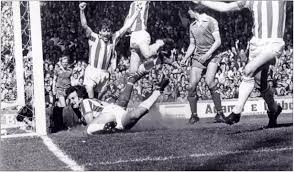
Naturally, Ian Robins scored both goals. Walsall lost and the League title was secured.
Fiona is now a hotelier.

 townreports
Hilarious!
LikeLike