10 out of 12 ain’t bad
While Liam Manning couldn’t match Michael Duff’s four opening wins as a new Town manager, a rescued point against a surprisingly strong Blackpool side — given their league position and away form — was a relief.
Worryingly, the team’s reaction to adversity, the principal quality of his short tenure, was rather lacking this time when the Seasiders opened the scoring with a goal created from chaos following a corner.
Up until that setback, Town had been the better of the two sides, with Dion Charles carving out two good opportunities with some deft footwork: one for Mumba, who could only divert his colleague’s ball wide at full stretch, and one for himself, which he smashed against the post from a tight angle.
Much of Town’s progressive play, however, was far too often interrupted by the out-of-form Gooch’s insistence on hitting the first tangerine shirt with every crossing opportunity from open play, corners and free kicks.
With McGuane and Ledson playing too deep, the left side of the attack striving but failing to deliver threat, and a virtually anonymous Humphreys offering little, the swagger of late was missing.
Blackpool, something of a nemesis in recent times, defended solidly and largely with comfort before challenging Town’s back three down the sides, from whence their opener came.
A relatively cheap corner conceded by Balker, covering for a well-beaten Gooch, was either deliberately swung over high and long or mishit, but either way it reached Husband, who once graced this patch with little distinction. His lob in the direction of the far post was met by the corner-taker, Clarkson, who hit a volleyed pass to Fletcher, who bundled home from short range.
If that sounds like bagatelle, that’s because it looked like it, with motionless Town defenders seemingly mesmerised by a routine which, if deliberate, was brilliantly executed. Much more likely, and no less admirable, it was the visitors reacting far better and quicker to events than a static home defence, followed by a disappointing effort from Nicholls in goal.
Worryingly, the Terriers immediately lost their way in a manner reminiscent of the worst days under Grant (and others, in fairness), with a confidence plunge and a functional breakdown exacerbated by yet another changed defence — and Low was missed — Gooch’s drop-off in form, the aforementioned lack of influence from Humphreys, and Charles’s moments of inspiration already becoming distant and fleeting memories.
Blackpool smelled blood, and a crowd grown weary by too many similar circumstances quietened and grew increasingly frustrated. An excellent start by Manning has been just that — a beginning, a reset and an opportunity to banish the prevailing negativity, with many wrongs still to right.
His two previous home games had delivered resilience and mental toughness when things didn’t go to plan, with the same qualities also drawn upon at London Road after being pegged back. But the response to Blackpool’s opener was inadequate, to say the least, and became worse on the half-hour when Fletcher bullied Wallace in the air to maintain a promising attack, ending with Anderson meeting little resistance when heading home a Walters cross.
Just before half-time, another looping corner by Clarkson evaded every Town defender, and Nicholls had to push an effort from Fletcher over the bar to ensure that a very poor half didn’t become an entirely disastrous one.
It was surprising that Manning didn’t make substitutions at the break, having witnessed his new team’s worst half of football by a distance, but perhaps he was charging the original eleven to put things right — which they most definitely did not.
Indeed, Nicholls had to make a good save from a first-time effort by Fletcher after McGuane inexplicably allowed a ball to drop and bounce rather than clear it.
Town hadn’t been helped by a fussy and inconsistent refereeing performance, with robust Blackpool challenges unpunished or ignored altogether, but nothing was working for the hosts as they and the crowd struggled to recapture the recent zeitgeist.
Kasumu replaced the ineffective Humphreys, which gave Manning’s team more energy and impetus, puzzling as it was that the change hadn’t been made at the break. The original call to favour craft over graft was a reasonable one, but the scale of the creative failure in the first half strongly suggested the substitution was needed earlier.
Charles, who had done little since creating two early chances, was also hooked for Wales. The debutant looked very young and very raw for 15 minutes — probably because he is, indeed, young and raw — but showed some nice touches and promise late on.
However, it wasn’t until Sorensen and Miller came on, accompanied by a change of shape, that Town’s fortunes began to change, if imperceptibly at first.
Sorensen replacing Gooch was an obvious — and again, too long overdue — swap, but Miller’s introduction saw Feeney, who was less than impressive throughout, depart and Balker move central alongside Wallace.
Suddenly, Town’s right side carried threat. In fairness to Gooch, he didn’t get a lot of support, but his poor use of the ball handicapped the team until his withdrawal. Miller and Sorensen’s partnership was tight and threatening, and both had a decisive hand in the goal which lifted the team and stirred anxiety in the ranks of the West Coast outfit.
Though it was an excellent Sorensen cross met by Harness for Town’s lifeline goal, Miller had nicked the ball away from a defender to give the Dane possession. Harness finished well with his head.
An enlivened crowd lifted the home team, and a further goal began to look increasingly likely. While some attempted moves were thwarted by the visitors, there was a vibrancy about Town which had been missing for the best part of an hour.
Sorensen had two ineffective efforts, one well wide and one easily saved, but it served to maintain the momentum against a side with increasing doubt hovering over them, and the influential Miller started to get the better of defenders who had enjoyed a comfortable ride up to that point.
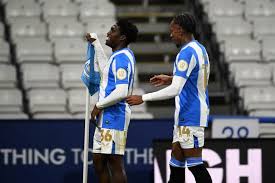
A lovely combination down the left, inevitably involving Miller, created the equaliser for recently introduced Ashia, when Mumba was slipped in beautifully to deliver a very good cross for Cam Ashia to head in at the far stick.
With the leveller, Manning added another way to avoid defeat to his CV, following the two red-card games and bouncing back after being two down, though this was the least satisfying by far — and not just because it still felt like three points lost, not one gained.
That point may still have been lost in injury time when Blackpool failed to capitalise on another well-delivered set piece, while Town couldn’t quite gain any injury-time momentum.
In fact, they were largely foiled by the overly fussy referee in this period, as he gave two ridiculous foul decisions against Wales and Ledson and, more egregiously, put an end to a Town quick throw to finally book a Blackpool player.
A win would have been undeserved and, despite the late flourish, it could be argued that a strong and disciplined Blackpool should have taken the spoils.
Disappointment at dropped points aside, Manning will surely have learned things about his squad on this occasion — the least convincing of the performances under his watch.
It is easy to suggest that he would have sacrificed a lot to get ten points from his first four games, and while the crowd is going to take a lot of convincing, the foundation has been built.
 townreports